Voltage glitch and fuse burn: unlocking the 8 GB CMP 170HX
The method is Kate Land's (blog post of November 2026), the tools were refined by the community and by darkmaniac7's lab. We reproduced it on our bench and burned 17 of our 25 cards. This page adds what other write-ups leave out: how a stubborn card behaves, what the overlap mode is, and how to solder a bench that does not kill the card.
A reminder: fuse burns are irreversible. OTP bits go from 0 to 1 only. A wrong plan or copying another card's plan leaves the card that way forever. Everything below comes with no warranty, use at your own risk.
In short: what the glitch does
On the 8 GB CMP 170HX everything is unlocked "on paper": five HBM stacks (80 GB) on the board, up to 128 SMs,
Gen4. Blocks are disabled by fuses the GPU reads in the first microseconds after reset, before boot
proper. Software cannot write new fuses: the write path is gated by DISABLE_SW_OVERRIDE.
The glitch opens that gate for one boot: over PMBus we ask the MP2888B supply controller to dip the core rail (NVVDD) exactly while the GPU reads its fuses. One bit reads wrong, the gate is "open", and until the next cold boot the owner may append permanent fuseless-fuse (FF) records. The glitch shots themselves change nothing: power-cycle and the card is stock again. Only the written FF records are permanent.
What we append (via ffcalc plans, see also the overview):
- SMs: relax the GPC/TPC masks down to the silicon's own ceiling (108–128 SMs on our cards, up from 74).
- Memory: FBP mask 0x852 → 0x840 — the fifth HBM stack comes up: 80 GB (81920 MiB under a geometry-aware driver).
- PCIe: Gen3/Gen4 records (including
magic_d) — the card starts advertising 16 GT/s.
Never touched: NVLink, MIG/sys_pipe, ECC, device-ID, factory bits with "bit 5", defective blocks.
The bench
A separate Linux host (any desktop board with a PCIe x16 slot; no iGPU needed, everything runs over ssh):
| Part | What you need |
|---|---|
| Host | Linux, Secure Boot off, lockdown [none], pci-stub bound to 10de:20c2, pci=noaer, no nvidia/nouveau drivers |
| Airflow on the card | mandatory: the hunt temperature gate works in the 36–41 °C band; a hot card drifts out of the window |
| Pico glitcher | Raspberry Pi Pico / Pico 2 or WeAct RP2350A (compatible pinout), powered from USB only |
| Switched outlet | a cold boot after every burn and a power cycle between runs — without it the hunt is manual (ours is Tuya + AC BACK = Always On in BIOS) |
| Multimeter | to find the NVVDD cap (~0.7 V) and ring out the points |
Wiring and soldering
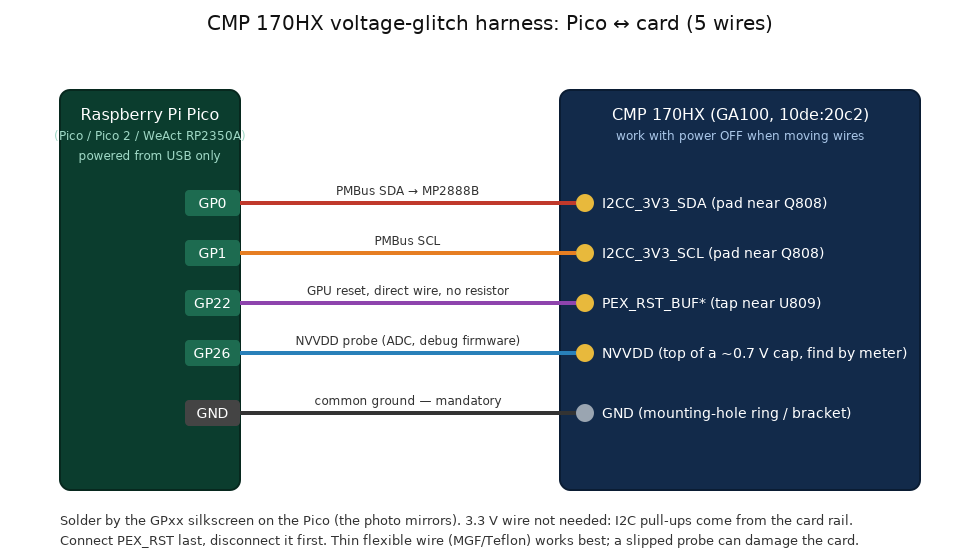
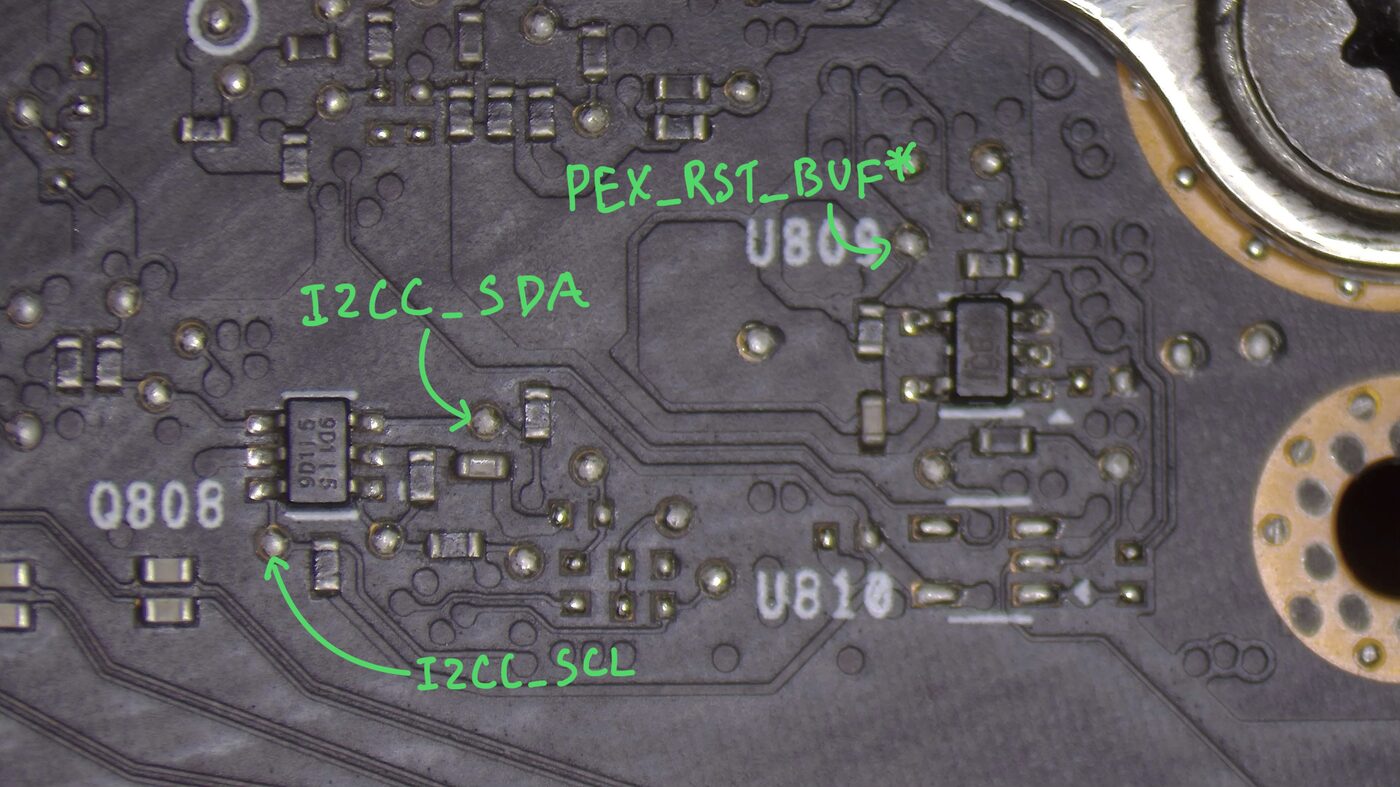
Five wires. Four are required (GP0/GP1/GND, plus GP22 to recover the card from wedges without cutting power); the fifth is a probe, see "calibrate by the real trough" below.
Lessons that cost us time:
- Solder by the GPxx silkscreen on the Pico board, not by photos — pictures online are often mirrored.
- Use thin flexible wire (ours is MGF/Teflon); stiff wire rips the pad when snagged.
- Move wires only with the host unpowered. Connect PEX_RST last, disconnect it first.
- Find NVVDD with a meter: ~0.7 V on the top of a capacitor while the card is alive.
- Do not power the Pico from the card; do not run a 3.3 V wire — the I2C pull-ups sit on the card's rail.
Glitcher firmware
Take dalzyu/pico-ga100vfi (base e1ebd97) and the lab's 12 patches
(cmp170hx-8gb-vfi-tools/firmware/*.patch, git am). The result is firmware push3; its marker is
fw=lab-psr1-push3.
Two builds:
- normal — routine hunting and burns;
- debug (
-DDEBUG=ON) — adds the GP26 ADC (the NVVDD probe), dip traces, 400 MHz.
We run burns on the debug build with the probe — see calibration below. Putting the Pico into BOOTSEL is a physical button only (software reboot wedges it).
Host tools and our patches
ga100vfi(host package of pico-ga100vfi) — baseline, classify, attempt, campaign.cmp170hx-8gb-vfi-tools— preflight, snap, the lab's hunter and runner.cmp170hx-ffcalc— the burn plan andburntool.
Without three fixes the burn did not work on any of our cards (patches in /files/glitch/patches/):
- EN_SW_OVERRIDE before SENSE in
burntool(missing inffcalc): otherwise EFP never raises and the write isREFUSED: EFP_STATUS=0. - CLEAR_FAULTS in the campaign loop: after a shot the MP2888B sits in a CML fault that a warm reboot
does not clear; PMBus
0x03clears it without power-off. Without it the dip floor sticks around ~530 mV and every card looks stubborn. - Burn in the same process that caught the goldilocks frame: the window lives for a fraction of a
second; launching
burntoolseparately is too late.
The standard procedure (takes about two thirds of cards)
- Cold baseline:
ga100vfi baseline+vfi_snap --rows(two identical reads), keep the snapshot — you plan by it and verify "is this the card we think" by it. vfi_preflight --enable-decode→ PREFLIGHT OK.- Hunt with
ga100vfi campaign ... --budget 500 --adaptiveuntil a goldilocks frame:DSOV=0,CRC=0x55, privilege mask0xFFFFFFFF. ffcalc gen --skip nvlink_disable,sys_pipe_disable→ a minimal plan for this card;simwith 0 errors; human check: bit 5 clear in every new record, device-ID untouched, rows in the free area.burntoolwrites the records with read-back, stops on the first error.- Cold boot (full power removal; ours is the outlet) → re-read: SMs up, FBP 0x840, LnkCap Gen4, and the plan regenerates as NO-OP. Only this confirms the burn.
What our batch taught us:
- A card with a defective GPC is almost always easy — one hunt, one hit (with exceptions, see below).
- Top silicon (all 8 GPCs alive) is ~50/50: either the standard works (one goldilocks came on shot 470 of a 500 budget — do not cut the budget early), or it is a ladder card.
- Poison on SENSE (
FUSECTRL=0xBADF...) is routine: the shot went too deep, nothing was written, the card is fine — power-cycle and retry. On a host with an Intel root complex never read BAR0 of a poisoned card before parking it: the CRS retry freezes the whole host.
Calibrate by the real trough (GP26 probe)
MP2888B VID commands are discrete (6.25 mV steps), but the actual dip trough lands 39–60 mV below the command, per card, stable within a card. Aim by the fact, not by the number:
- the debug firmware + probe + trace prints each shot's trough (
trough_mvin the log); - two shallow shots at session start measure this card's offset;
- every depth in the plan comes from "target trough + measured offset", not from someone else's commands.
The lab's cards hit at a real trough of ~334 mV; the first shot after a park is 26–40 mV shallower than the rest — never score it (our runner already skips it).
Stubborn cards: the ladder
Our last seven cards (124–126 SM, plus one 112) gave no goldilocks in any full 500-shot budget with any shape push2 can fire. Their behavior is a three-step ladder with no gaps:
| Frame | DSOV | CRC | meaning |
|---|---|---|---|
| light / under | 1 | 0x55 | core disturbed, fuse gate not opened |
| over | 0 | 0x00 | gate opened, blocks wiped — too deep / too long |
| lost | — | — | the card dropped off the bus |
Between "under" and "over" there is no VID code at all (the boundary sits between adjacent 6.25 mV steps), and no amount of delay/depth sweeping lands inside it. This is not "the wrong depth" — it is another class of cards (card E/C profile in the lab docs).
The overlap mode (push3)
The key to ladder cards is the rail's behavior at the moment the reset is released (PEX_RST). Push2 refuses PMBus writes in flight across the release: at the release the rail is either already up (→ under) or still low and rising immediately after — that few-microsecond gap is the window push3 opened.
Push3 allows the restore write to fly across the release: the dip starts before the release, the rail is still low at t=0 and comes back up a few microseconds after. Card E in the lab gave nothing in three days and 3000+ push2 shots, and a goldilocks on shot 13 of the first push3 overlap run (window: the rail back up at +7 µs after the release).
How the overlap hunt goes (per docs/OVERLAP_EDGE.md):
goldilocks_hunt.py overlap --out plan.json— a cell plan: depths shallow→deep (our defaults 388→369, deeper by calibration for cards with a heavy undershoot), two dip-write starts (writes at −177 and −130 µs from the release), rail-back-up times 0/3/7/11/17 µs after the release plus a +48 anchor;tvpinned (the stock 787.5 mV write at the same place in every shot, otherwise two things move at once).- First pass: one shot per cell; where a depth shows the over→under edge, walk it at 1 µs steps and dwell.
- Take only a
DSOV=0 + CRC=0x55 + PLM=0xFFFFFFFFframe, then your own active sense (EN_SW_OVERRIDE=1) and burn while the frame is held.
Honest caveats we can see on our side: overlap is a young method (21.11.2026), nobody outside the lab has burned a card with it yet, and some ladder cards may have no window at all (one of the lab's four never gave one in ~4000 shots). We are starting our series of seven and will update this page per card.
One more between-codes tool is dither (revert 2): the firmware alternates the train's pulses between
two adjacent VID codes, landing the average depth between the steps. The lab did not finish a card with it;
it is next in our queue.
Safety, short version
- Plan from this card's cold read only; check the serial/die-ID before burning (two crystals with identical masks are otherwise indistinguishable).
- sim/verify/human "yes" before any write. Never
--force. - Poison/wedge → power cycle, not software tricks; a warm reboot does not clear the supply controller fault.
- Fuse dumps and goldilocks logs identify the card — scrub them before publishing.
- Burn with airflow and a trough trace; after it, cold boot and re-read.
Automation
Hunting is thousands of shots, and our whole loop is automated: a controller (any machine with ssh to the
host) drives the hunter's plans; the power cycle, the fresh-boot guard, preflight, card identity by masks
and die-ID, the temperature gate and the runner are the lab's (bootrun.sh; we added the smart-plug mode).
A night session of hundreds of shots needs no human; a human is needed for physical steps (swap the card,
solder the probe) and for the burn decision.
Links
- Kate Land, the method write-up
- kate-land/ga100vfi, dalzyu/pico-ga100vfi
- the lab: cmp170hx-8gb-vfi-tools (docs/OVERLAP_EDGE.md, PUSH3.md, SWEET_SPOT.md)
- cmp170hx-ffcalc
- our patches, cmp.wiki